





I still remember my first domain purchase. I was 19, sweating over my keyboard, convinced that if I didn’t grab “akram.com” in the next 30 seconds, my entire future would collapse. If you’re just starting out and want a structured path to learn everything about WordPress, check out this complete WordPress tutorials guide for beginners and experts.“
Spoiler alert: I let it expire three months later.
That mistake taught me something valuable: a domain name isn’t just an address—it’s the foundation of your entire online presence. Pick wrong, and you’ll fight an uphill battle forever. Pick right, and everything else gets easier.
In this guide, I’m sharing exactly how I help WPThrill readers choose domains that actually work in 2026. No recycled advice from 2015. No “just buy the .com” nonsense that doesn’t reflect reality anymore. Just practical, field-tested strategies you can use today.
Let’s dive in.
Before We Start: One Important Truth About Domain Names
Before I give you the 7 tips, I want to make one thing clear.
Your domain name will not make you successful.
But the wrong domain name can absolutely slow you down.
Over the past few years, I’ve reviewed dozens of beginner WordPress sites. The pattern is predictable:
-
Overly long keyword domains
-
Hyphen-heavy spam-looking URLs
-
Names that box the owner into one niche
-
Domains that sound impressive but are impossible to remember
And almost every time, those site owners eventually say:
“I wish I had thought this through more.”
This guide exists so you don’t have that regret two years from now.
Now let’s build this properly.
Why 2026 Changes Everything About Domain Names
Before we jump into the tips, you need to understand why the rules have shifted.
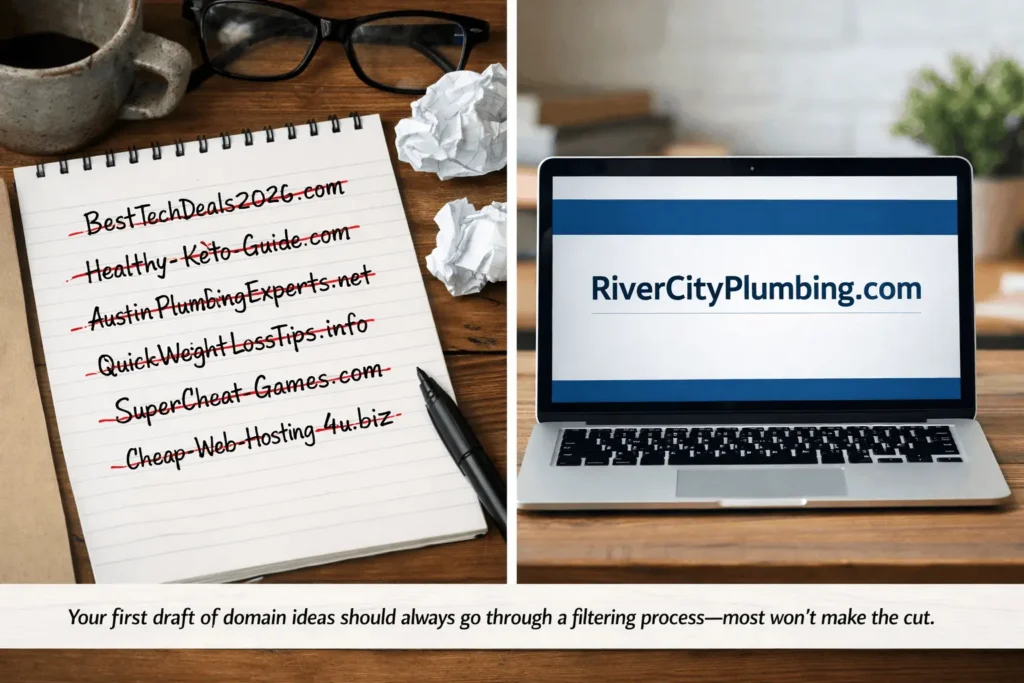
Five years ago, the game was simple: grab a keyword-rich .com, stuff it with content, and watch Google send traffic. Today? Search engines are smarter. AI overviews dominate results. And users have developed “banner blindness” for anything that looks like a spammy keyword domain.
The data backs this shift. Industry reports over the last two years show that new domain extensions (.ai, .studio, .shop, .dev, etc.) are growing significantly faster than traditional .com registrations. Businesses are no longer defaulting to .com — they’re choosing extensions that communicate relevance and modern positioning.
And this matters psychologically.
When users scan search results in 2026, they aren’t just reading titles. They’re pattern-matching trust signals. A clean, relevant domain stands out more than a long, generic keyword string.
Relevance now beats tradition.
So forget everything you think you know. Let’s start fresh.
Tip 1: The Radio Test (If They Can’t Say It, They Won’t Remember It)
Here’s a simple test for every domain you consider: Could you say it over the phone without spelling it?
I call this the “Radio Test.” If someone hears your domain mentioned on a podcast or radio ad, can they type it correctly without asking for clarification?
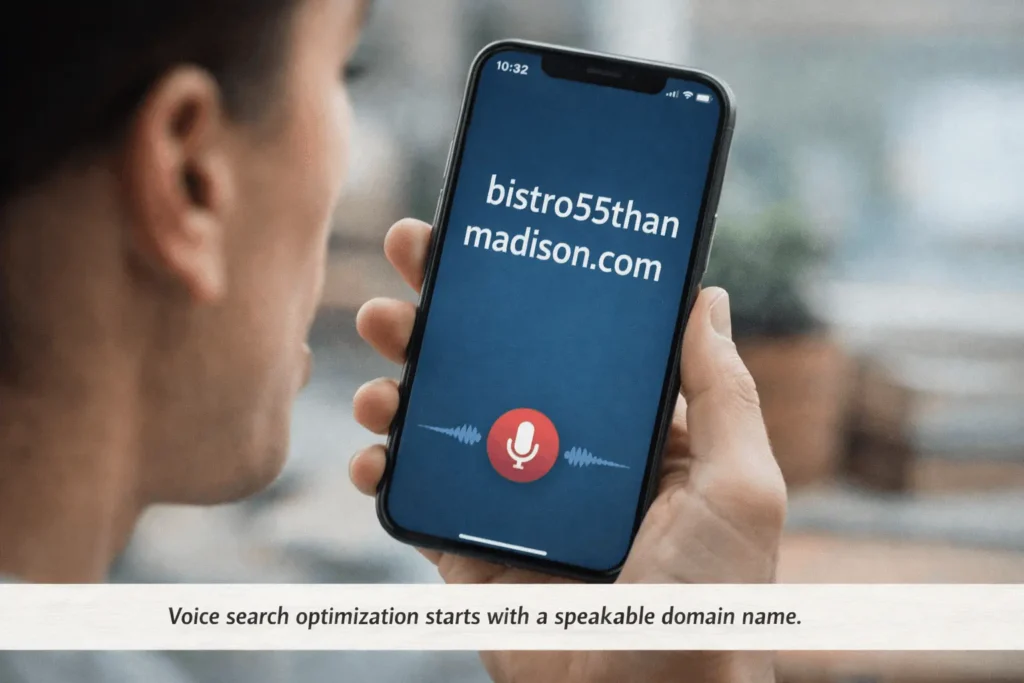
I watched a local restaurant near me learn this lesson painfully. They registered “bistro55thandmadison.com” because it described their location perfectly. Sounds reasonable, right? Except every time they mentioned it on their Instagram stories, people typed “bistro55thandmadison” and landed on a parked domain. They lost months of potential customers.
The 2026 Reality
With voice search continuing to grow, this matters more than ever. Someone asking Siri or Google Assistant to find your site needs a name that sounds natural when spoken aloud.
Practical rule: Write down your potential domain. Hand it to someone who has zero context about your business. Ask them to read it back to you. If they hesitate or mispronounce anything, back to the drawing board.
Tip 2: Brandability Beats Keywords in 2026
I need you to hear me on this because it’s the most common mistake I see beginners make.
There’s a persistent myth that your domain must contain your primary keyword to rank. “If I’m a plumber in Austin, I need austinplumber.com or I’ll never show up on Google!”
This myth refuses to die, but search engines killed it years ago.
What Actually Happens
Google’s algorithm in 2026 is sophisticated enough to understand what your site is about without keyword hints in your domain. In fact, exact match domains (EMDs) often carry a subtle stigma now. Why? Because spam operators abused them for years, stuffing low-quality sites with keywords to game the system.
When Google sees “bestchicagopizzadelivery.com” in 2026, there’s a tiny part of its algorithm that instinctively raises an eyebrow. Not a penalty, but not the trust boost you might expect.
The Better Approach
Focus on brandability instead. Think about successful companies:
-
Google (not “search-engine.com“)
-
Amazon (not “buy-books-online.com“)
-
Tesla (not “electric-vehicles.com“)
These names mean nothing in a keyword sense and everything in a brand sense. They’re memorable, ownable, and flexible enough to expand into new markets.
Your goal isn’t to describe every service you offer in your domain. Your goal is to create something people remember and trust.
A Real Example: Why We Chose WPThrill
When I was choosing the name WPThrill, I didn’t try to include every keyword possible like:
-
bestwordpressguides.com
-
wordpress-tutorials-2026.com
-
learnwordpressstepbystep.com
All of those describe the niche. None of them build a brand.
“WPThrill” works because:
-
It’s short.
-
It’s easy to say.
-
It passes the Radio Test.
-
It’s flexible (I’m not boxed into just tutorials).
-
It feels energetic and modern.
It doesn’t scream SEO.
It feels like a brand.
That’s the difference.
Tip 3: Master the New Extension Landscape
I mentioned earlier that .com isn’t the only game in town. Let me show you exactly how to navigate the 2026 extension landscape.
When to Stick With .com
Despite what I said about new extensions, .com still carries weight in certain situations. If you’re building:
-
A mainstream business targeting older demographics
-
A site you plan to sell someday (.com retains better resale value)
-
Anything where absolute maximum trust is critical
Then yes, fight for a .com if you can find one that works.
When to Embrace Alternatives
Here’s where new extensions shine:
Tech/Startups: .ai, .io, .dev
Example: Your startup builds AI writing tools. “wordcraft.ai” sounds instantly more credible and modern than “wordcraftai.com” which looks like you couldn’t get the real .com.
E-commerce: .shop, .store, .market
Example: “vintagetreasures.shop” tells visitors exactly what to expect before they click. That clarity can boost click-through rates from search results.
Creative Portfolios: .studio, .design, .photography
Example: “morganwalsh.photo” is cleaner than “morganwalshphotography.com” and leaves a more professional impression.
Local Business: .nyc, .london, .tokyo
Example: “authenticbaguette.paris” builds instant location authority that a .com simply cannot match.
The Strategy
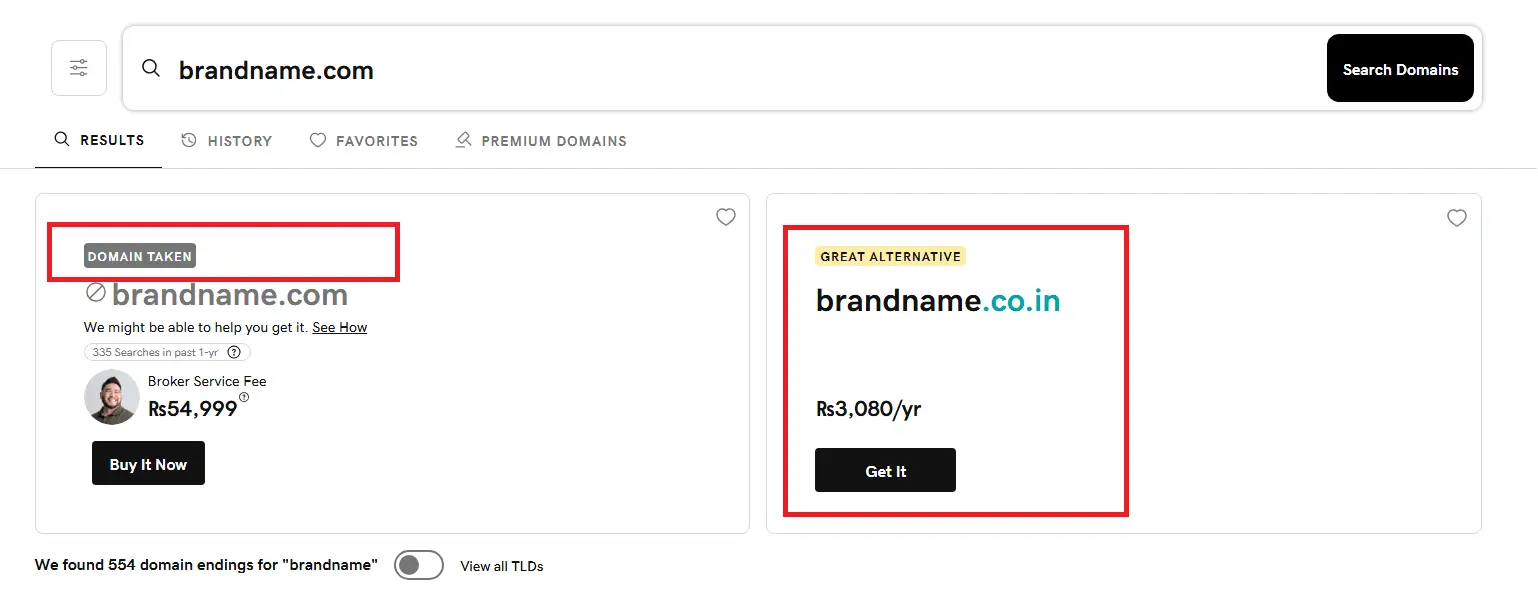
Search for your ideal brand name with different extensions. If brandname.com is taken but brandname.studio is available, you have a decision to make. Ask yourself: does the extension add meaning or detract from it?
For most creative and technical fields in 2026, the right new extension actually enhances your brand rather than diluting it.
Tip 4: The Idea Volcano Method (Brainstorm Before You Search)
Most beginners search first and think later. That’s backwards. The Idea Volcano Method flips that mistake on its head. Here’s the fastest way to disappoint yourself: open a registrar’s search bar and start typing random words.
You’ll find everything taken, get frustrated, and settle for something mediocre. I’ve watched dozens of clients do this.
Instead, build an idea volcano first. Spend 30 minutes generating possibilities without checking availability. Quantity matters here—aim for 50–100 raw ideas.
How to Erupt Your Volcano
Method 1: Word Combining
Take words related to your industry and smash them together unexpectedly:
-
Tech + Comfort = Techfort
-
Travel + Compass = Travpass
-
Coffee + Ritual = Cofritual
Method 2: The Thesaurus Gambit
Write your core business word. Now find 10 synonyms. Mix and match:
-
Plumber → Pipe, Flow, Drain, Fix, Tap, Water
-
Austin → ATX, Capital, Hill, River, Lone Star
Combine them: FlowFix, TapATX, LoneStarPipe
Method 3: Borrow From Other Languages
A word that’s common in English might be beautiful and unique in another language. Just make sure it’s pronounceable and doesn’t accidentally mean something offensive. (Please run this by a native speaker.)
Method 4: Use AI as Your Brainstorming Partner
Open ChatGPT or Claude and prompt: “Generate 50 brandable domain name ideas for a [your industry] business targeting [your audience]. Focus on short, memorable, made-up or combined words.”
AI won’t give you the final answer, but it will spark directions you hadn’t considered.
Only after you have your volcano of ideas do you start checking availability. This approach guarantees you’ll have backups when your first choice is taken.
Tip 5: Audit for Hidden Landmines
You’ve found a name. It’s available. The extension works. You’re ready to buy.
Stop. Run these five checks first.
Check 1: Social Media Handle Availability
Visit namechk.com or usernamecheck.com. Type your proposed name. If the Instagram, Twitter, and TikTok handles are taken by inactive accounts or (worse) spam, you’ll struggle to build consistent branding.
I’ve seen businesses rebrand entirely because they locked their domain only to discover @theirbrand was already held by a bot account demanding payment.
Check 2: Quick Trademark Search
Visit the USPTO database (or your country’s equivalent). Search for your proposed name. If a registered trademark exists in your industry category, walk away. Legal fights are expensive and miserable.
Check 3: The “Typo Squatting” Test
Type common misspellings of your domain. If someone already owns the typo version and parked ads there, you’ll lose traffic forever. Consider registering the typo yourself if it’s significant.
Check 4: Google It (The Incognito Way)
Open an incognito window. Search your proposed name. What comes up? If you see an existing business with the same name (even with a different extension), you’ll create confusion. If you see unrelated content, that’s fine. If you see adult content or anything sketchy, run.
Check 5: Say It With an Accent
Read your domain aloud with a heavy accent—French, Australian, Indian, whatever you can mimic. Does it sound like something else? Does it accidentally resemble a curse word or inappropriate phrase in another language?
I knew a consultant who launched “speedofart.com” for a creative agency before someone pointed out how it sounded when spoken quickly. Landmines are everywhere.
Tip 6: Consider the “Business Card Test”
Here’s a mental exercise I use with everyone I coach.
Imagine handing someone your physical business card. They glance at it, slip it into their pocket, and go about their day. Three weeks later, they’re cleaning out their desk and find your card. They think, “Oh right, I needed to check them out.”
Can they type your domain from memory without checking the card?
This is the Business Card Test. It’s brutal but necessary.
If your domain is:
-
Too long
-
Too complicated
-
Uses unusual spelling
-
Has hyphens
-
Uses numbers instead of words
You fail the test.
Why Hyphens and Numbers Fail
“best-nyc-plumber-24-7.com” looks like a domain that will 100% be forgotten or mistyped. Was it nyc-plumber or nycplumber? Was 24-7 written as numbers or words?
Every hyphen and number creates a decision point for the user. Decision points create friction. Friction kills traffic.
The same goes for creative spelling like “fotograf” instead of “photograph.” Unless you’re building a brand where that spelling is central (like Tumblr or Flickr), stick with standard spelling. Users will default to the standard version when guessing your URL.
Tip 7: Move Fast When You Find “The One”
You’ve generated ideas. You’ve filtered through checks. You’ve found something that passes all tests.
Now buy it immediately.
Domain registrars track search data. If you search for a domain repeatedly without purchasing, some registrars will flag it as “in demand” and either raise the price or snap it up themselves through backorder services. This practice (domain front-running) is controversial but real.
The 24-Hour Rule
When you find a domain that excites you, give yourself 24 hours to sit with it. Tell a few trusted friends. Sleep on it. If you still love it tomorrow, purchase.
But don’t wait a week. Don’t “think about it.” The domain market moves fast, and the perfect name won’t wait for your indecision.
Registration Length
Here’s a small pro tip: register for at least two years initially. Google has never officially confirmed this as a ranking factor, but multiple SEO studies over the years suggest longer domain registrations may correlate with higher trust signals.
Common Domain Name Mistakes Beginners Still Make in 2026
Even with all this advice available online, I still see the same mistakes repeated over and over.
Let’s make sure you don’t fall into them.
1. Choosing a Domain That’s Too Niche
If you start with something like:
bestwordpressspeedoptimizationtips.com
What happens when you want to expand into themes? Plugins? Hosting reviews?
You’ve boxed yourself in before you even begin.
Choose something flexible enough to grow with your ambitions.
2. Picking a Trendy Word That Ages Poorly
Internet slang changes fast. Words that sound cool today might feel outdated in two years.
Your domain should feel stable — not trendy.
3. Ignoring Email Branding
Remember: your domain becomes your email.
hello@yourdomain.com
support@yourdomain.com
If your domain looks spammy, your emails will too.
That affects trust instantly.
4. Buying Without Checking History
Sometimes a domain looks available — but it was previously used for spam or adult content.
Before buying, check its history using:
-
Wayback Machine (archive.org)
-
A quick Google search of the domain
You don’t want to inherit someone else’s bad SEO reputation.
5. Waiting Too Long to Decide
Analysis paralysis kills momentum.
You don’t need perfection.
You need something strong, clean, and flexible — then you build on it.
Bonus: My 2026 Domain Checklist
Before you click purchase, run this quick checklist:
| Check | Status |
|---|---|
| Passes the “radio test” (easy to say aloud) | ✔️ |
| No awkward spellings or hyphens | ✔️ |
| Available social handles match | ✔️ |
| No conflicting trademarks | ✔️ |
| Clean Google search results | ✔️ |
| Extension makes sense for your industry | ✔️ |
| Passes the “business card test” (memorable) | ✔️ |
| You genuinely like saying it | ✔️ |
What If Your First Choice Is Taken?
This happens constantly. Don’t despair. Try these strategies:
Add a prefix/suffix: hello[yourname], get[yourname], try[yourname], [yourname]app, [yourname]hq
Try a different extension: If .com is taken, check if .co, .io, or an industry extension works
Combine two words creatively: Instead of “smithphotography.com” try “smithlens.com” or “smithcaptures.com“
Use your name: Personal brands work beautifully. JohnSmith.photo or SarahCodes.dev feel authentic and professional
Final Thoughts
Choosing a domain name in 2026 isn’t about finding the one perfect option that describes everything you do. It’s about finding something memorable, trustworthy, and flexible enough to grow with you.
The domain you choose today will appear on business cards, social profiles, email addresses, and marketing materials for years. A little extra time spent upfront pays dividends forever.
And remember: your domain is just the beginning. Once you’ve secured it, the real work starts—building something worth visiting.
If you’re just getting started, I highly recommend reading What Is WordPress and How Does It Work? to understand the foundation you’re building on.
And before you publish your first page, make sure you go through How to Plan a WordPress Website: Step-by-Step Beginner Blueprint. A strong domain + a clear site structure is a powerful combination.
If you’re unsure about themes or plugins after registering your domain, these guides will help: WordPress Themes Explained and What Is a WordPress Plugin?
Planning to register a domain soon? Drop your top 2 ideas in the comments or reach us through the contact us page form and I’ll tell you which one has stronger long-term brand potential.
And if you’ve already made a domain mistake in the past — share it. Your experience might save someone else from repeating it.
Frequently Asked Questions About Choosing a Domain Name
Is .com still the best domain extension in 2026?
It depends on your audience and industry.
For mainstream businesses targeting broad or older audiences, .com still carries strong trust signals. However, for tech startups, creative professionals, local businesses, and e-commerce brands, industry-specific extensions like .ai, .studio, .shop, or .dev can communicate relevance more clearly and feel more modern.
The best extension is the one that supports your brand positioning — not just tradition.
Do keywords in domain names still help SEO?
Very little.
Google’s algorithms now understand context, intent, and topical authority without relying on keywords inside the domain name. In many cases, brandable domains outperform keyword-stuffed domains because they build stronger trust and memorability.
Focus on brand strength first. SEO follows quality content.
How long should a domain name be?
Shorter is better — but clarity matters more than character count.
Aim for under 15 characters if possible. Avoid hyphens, numbers, and unusual spellings that create confusion. A slightly longer but clean and memorable name is better than a short but confusing one.
Should I buy multiple extensions of my domain name?
If your budget allows, securing key variations like .com, .net, or your country extension can protect your brand. However, it’s not mandatory.
Many successful businesses operate with only their primary domain extension. Protection is helpful — but consistency matters more.
Can I change my domain name later?
Yes, but it’s complicated.
Changing domains requires 301 redirects, SEO migration planning, email updates, social profile changes, and rebranding. You may temporarily lose search traffic and confuse returning visitors.
It’s far better to choose carefully now than fix it later.
How do I know if a domain name is truly “good”?
A strong domain name:
-
Passes the Radio Test (easy to say aloud)
-
Passes the Business Card Test (easy to remember)
-
Has no trademark conflicts
-
Matches available social handles
-
Feels flexible for future growth
-
Sounds like something you’re proud to say
If it checks those boxes, you’re on the right track.
Next Tutorial: WordPress Hosting for Beginners (What to Look for in 2026) (Coming Soon)
Previous Tutorial: How to Plan a WordPress Website: Step-by-Step Beginner Blueprint for 2026