



Your step-by-step performance optimisation guide for faster load times & better conversions
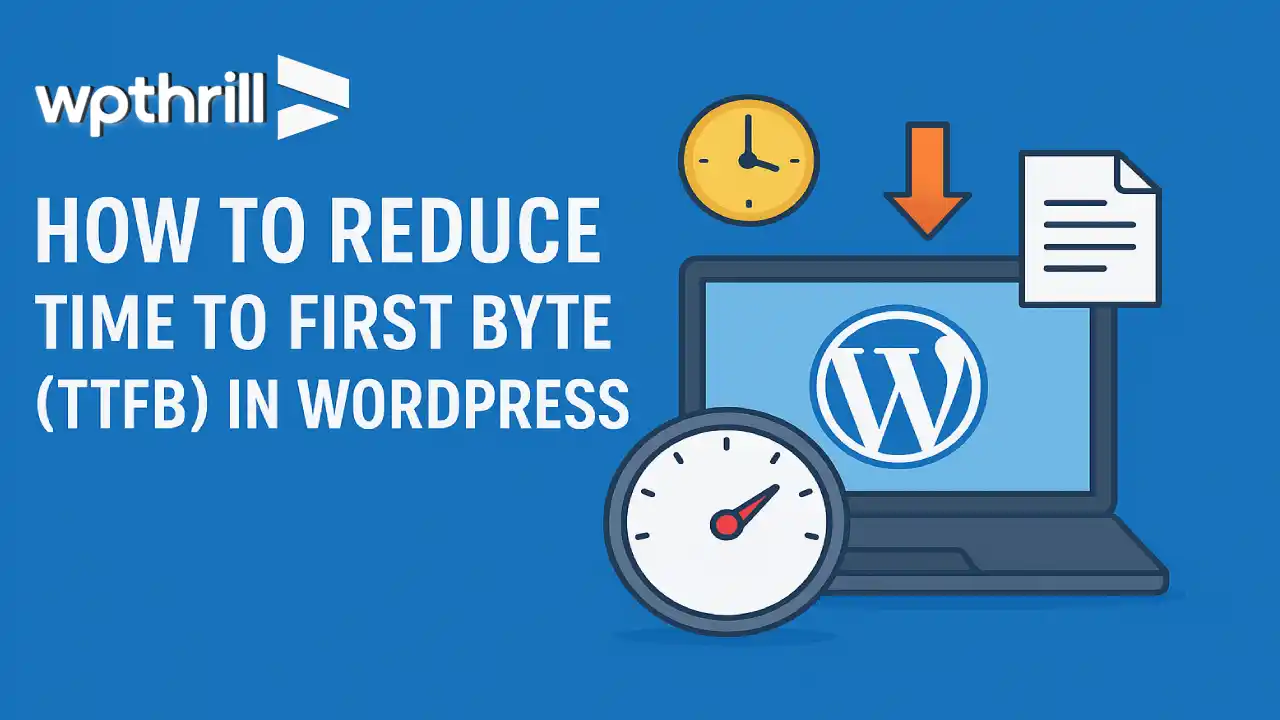
If you’ve ever run a speed test on your WordPress site, you may have come across the term Time to First Byte (TTFB). It’s one of those metrics that doesn’t always get the spotlight, but it plays a crucial role in how fast your site appears to users — and how well it performs for SEO and conversions.
In this guide, we’ll walk you through:
-
What TTFB is and why it matters for WordPress
-
How to measure it correctly
-
The typical causes of high TTFB on WordPress sites
-
A detailed 10-step strategy to reduce TTFB (with code where applicable)
-
Conversion-focused tips for faster user experience
-
Frequently Asked Questions (FAQs) and answers
Let’s dive in.
1. What is TTFB and Why It Matters
What is TTFB?
TTFB stands for Time to First Byte — i.e., the time elapsed from when a user’s browser (or client) sends an HTTP request, to when the browser receives the first byte of the response from the server.
In other words, it’s how long the server takes to start sending data. This includes:
-
DNS lookup and connection time
-
TLS/SSL handshake (if HTTPS)
-
Server-side processing (WordPress PHP, database queries, theme/plugin logic)
-
The network latency for the first byte to travel back to the client
Why should we care?
Here are the key reasons:
-
A lower TTFB means your server starts delivering content faster — which translates into quicker perceived load times.
-
While TTFB itself isn’t one of the main Core Web Vitals (like LCP, FID, CLS), a high TTFB can negatively affect those metrics because the browser waits longer before receiving the HTML to render.
-
From an SEO and conversion viewpoint: slower responses = higher bounce rates, lower engagement, fewer conversions. A study noted that mobile users often abandon pages taking more than 3 seconds.
-
Many WordPress speed-audit tools flag “Reduce initial server response time” (which equates to TTFB) as a major recommendation.
What’s a “good” TTFB?
While absolute numbers vary, general guidance is:
-
Under ~200 ms: Excellent target.
-
Around 300-500 ms: Good for many WordPress sites, though room for improvement.
-
Over 600 ms: Likely indicates server/hosting or configuration bottlenecks.
Bottom line: reducing TTFB is foundational for faster WordPress performance. If your site is sluggish from the get-go, other optimisations (images, CSS/JS, etc) will have less impact.
2. How to Measure TTFB on a WordPress Site
Before you optimise, you need a baseline. Here are tools and methods:
-
Chrome DevTools: Network tab → check “Waiting” time for the document request.
-
WebPageTest: Run a test from multiple locations; look at the TTFB metric.
-
GTmetrix: On the Waterfall tab, you’ll see “Waiting” time – that’s TTFB.
-
Online tools: e.g., Geekflare TTFB Tool, etc.
Tip: Keep consistent test settings — same location, device type (desktop/mobile), connection throttling — to accurately compare before/after.
3. Common Causes of High TTFB on WordPress
Now let’s look at what causes TTFB to balloon. Understanding these helps you target the right fixes.
3.1 Slow Hosting or Poor Server Resources
A shared, overcrowded server, old hardware, or insufficient memory/CPU can delay response time. Many WordPress performance posts point to hosting as the primary root cause.
3.2 Geographical Distance & Network Latency
If your server is physically far from your user base, network latency contributes significantly to TTFB. Choice of data centre and use of CDNs play a part.
3.3 Outdated PHP / Software Stack
Running an outdated version of PHP, MySQL, or WordPress core can bog down performance. Upgrading often brings performance improvements.
3.4 Theme & Plugin Bloat / Heavy Database Queries
Complex themes, page builders, many plugins, database queries, or inefficient code will slow down the time WordPress needs to generate the HTML.
3.5 Lack of Caching / Dynamic Page Generation
Every page view triggers PHP + DB queries if caching isn’t in place — this increases TTFB.
3.6 DNS, TLS/SSL Handshake Delays
DNS lookup time, HTTPS handshake, and connection setup are part of TTFB. Slow DNS providers or older TLS versions will add latency.
3.7 Database Overload & Large Autoload Data
When your WordPress database is loaded with post revisions, spam comments, transients, etc, it takes longer to retrieve/serve the page.
Understanding the root cause(s) for your site is critical — you’ll save time by focusing on what’s actually holding you back.
4. 10-Step Strategy to Reduce TTFB in WordPress
Here is a practical, conversion-ready checklist. Each step includes what to do, why it matters, and code or plugin suggestions where applicable.
Step 1: Choose a Fast, WordPress-Optimised Hosting
What to do:
-
Use a managed WordPress host or one optimized for PHP and WordPress.
-
Ensure the physical server/data centre is close to your primary audience.
-
Check whether your host supports PHP 8.x and adequate RAM/CPU.
Why it matters: As noted above, hosting is often the first bottleneck.
Conversion tip: If you switch hosting and measure TTFB again, you can showcase “Before vs After” results (great for credibility and conversion) on your site.
Step 2: Upgrade PHP Version & Stack
What to do:
-
In your hosting panel, switch your site to the latest stable PHP version (e.g., PHP 8.1 or 8.2).
-
Update WordPress core, theme, and plugins to the latest versions.
Why: Newer PHP versions process WordPress code faster, handle requests more efficiently.
Code snippet (optional):
Add the following to your wp-config.php for debugging and forcing PHP to show version (optional use):
Step 3: Implement Full-Page Caching & Object Caching
What to do:
-
Install and configure a caching plugin (e.g., WP Rocket, W3 Total Cache, or use built-in host caching).
-
Enable page caching, browser caching.
-
For high-traffic sites consider object caching (Redis/Memcached).
Why: Caching means WordPress doesn’t need to regenerate the HTML for each request, dramatically reducing server processing time.
Code snippet (WP Rocket example):
Also, in WP Rocket settings: enable “Cache Lifespan”, “Mobile Cache”, “Preload Cache”.
Step 4: Use a Quality CDN & Optimize DNS
What to do:
-
Choose a CDN (e.g., Cloudflare, KeyCDN, BunnyCDN) and integrate with WordPress.
-
Use a fast DNS provider; consider Cloudflare DNS, Google DNS or others rated for low latency.
-
Ensure CDN is configured to deliver cached HTML (if possible) and static assets from edge locations.
Why: Reduces latency and geographical distance, improving the network portion of TTFB.
Code snippet (for Cloudflare in functions.php):
Step 5: Clean and Optimize the WordPress Database
What to do:
-
Remove post revisions, spam/trashed comments, transients, expired options.
-
Optimize MySQL tables (via phpMyAdmin or plugin).
-
Disable or limit autoload options if you have large wp_options autoloaded entries.
Why: Reduces query time and lowers server work before first byte.
Code snippet (to clean up transients – in a plugin or functions.php):
Step 6: Minify/Optimize PHP Execution & Theme/Plugin Bloat
What to do:
-
Audit your active plugins: remove unused or heavy ones.
-
Use a lightweight theme (e.g., minimal, well-coded framework).
-
Avoid excessive external calls, large bootstrap files.
-
Consider using OPcache (many hosts support it by default).
Why: Fewer PHP instructions and database calls mean faster generation of the page.
Step 7: Enable GZIP/Brotli Compression & HTTP/2 or HTTP/3
What to do:
-
Ensure server supports and has enabled GZIP or Brotli for HTML, CSS, JS.
-
Ensure HTTP/2 or HTTP/3 is enabled (especially if using HTTPS).
-
Configure via your hosting panel or
.htaccess/ nginx config.
Why: Decreases size of files to send and can reduce response overhead, indirectly improving TTFB.
Code snippet (Apache via .htaccess):
Step 8: Tune Server-Level Settings (Disk I/O, PHP-FPM, MySQL)
What to do:
-
If you have access, increase PHP-FPM workers, reduce max execution time, enable caching at server level.
-
Ensure fast storage (SSD/NVMe).
-
Configure MySQL to use InnoDB, proper caching, index optimisation.
Why: Server hardware and configuration are foundational to TTFB; even the best code will suffer on a weak stack.
Step 9: Warm the Cache & Avoid Cold Cache Penalties
What to do:
-
Preload your cache after publishing or after clearing.
-
Consider setting up heartbeat or cron schedule to keep pages warmed.
-
Avoid clearing caches on high-traffic times.
Why: A warm cache means the server can serve a cached page instead of generating on the fly — drastically reducing processing time before first byte.
Step 10: Monitor, Measure & Iterate
What to do:
-
Retest TTFB after each major change.
-
Monitor regularly (once a week/month) and keep a log.
-
Use real-user monitoring (RUM) tools if available to see what your actual users experience.
-
Document your “before/after” so you can show the improvements to stakeholders or clients.
Why: Performance is not a one-time fix — new plugins/themes, WordPress core updates, traffic surges all affect TTFB. Continuous monitoring ensures you stay ahead.
FAQs – Frequently Asked Questions
Here are some common questions (and answers) around TTFB in WordPress:
Q1: Is TTFB the same as page load time?
No. TTFB is only the time until the first byte of a server’s response arrives. Page load time covers the overall time until all resources (images, CSS, JS) load and the page is fully interactive. A low TTFB helps but doesn’t guarantee fast full page load.
Q2: Can I ignore TTFB if my page load time is already good?
While you might have acceptable page-load times, a high TTFB can be a hidden bottleneck — and may degrade performance under load or future changes. It’s best practice to keep TTFB low.
Q3: Which caching plugin is best for TTFB improvement?
There’s no one “best” plugin; what matters is correct configuration and that your host supports it. Plugins like WP Rocket, W3 Total Cache, or host-built caching are all viable. The key is using full-page caching and object caching correctly.
Q4: Does using a CDN always reduce TTFB?
Mostly yes — but only if the CDN is configured properly and able to serve the initial HTML (or your server is close enough). If your origin server is slow, or the CDN still needs to fetch from origin for every request, TTFB may still be high.
Q5: My TTFB is still high even after caching — what now?
Possible causes: slow database queries, heavy plugins/themes, server hardware limitations, or network latency. Use profiling tools (e.g., query monitor plugin) to identify slow queries, consider moving to better hardware or optimizing theme logic.
Final Thoughts
Optimising TTFB on your WordPress site isn’t glamorous — it’s foundational. But by reducing that initial time to first byte, you lay the groundwork for faster load times, better user experience, higher SEO rankings, and improved conversions.
Follow the strategy above, monitor your progress, and you’ll see meaningful improvements.
Any questions or if you’d like help auditing your own site’s TTFB, feel free to reach out. Let’s make your WordPress site lightning fast!